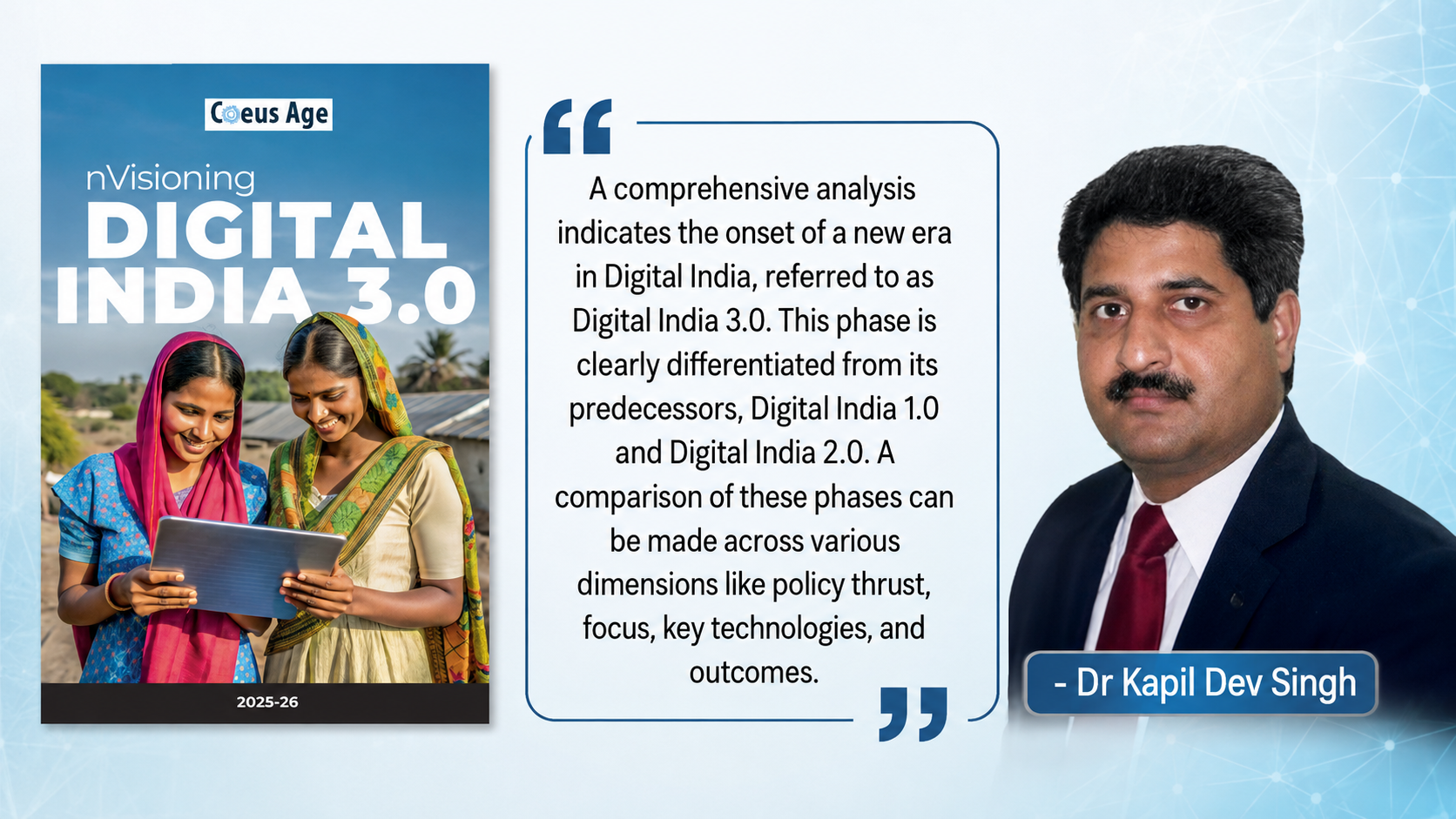
Coeus Age is delighted to introduce nVisioning Digital India 3.0, a Coffee Table Book that chronicles the progression of Digital India to date and anticipates its development in 2025 and beyond. One might wonder why it is essential to analyze this evolution.
The digital economy in India is projected to reach 1 trillion USD by 2030, significantly bolstering the nation’s economic growth both directly and indirectly. As we look ahead, the narrative of Digital India will center on four key themes: enhancing manufacturing capabilities for semiconductors, fostering a robust AI ecosystem, ushering into the next generation 6G telecom network, and strengthening cyber security measures. The semiconductor industry and electronic manufacturing sectors, along with artificial intelligence, are set to receive significant support through well-structured government initiatives, including the Production-Linked Incentive (PLI) scheme for mobile and hardware manufacturing, the India Semiconductor Mission, and the India AI Mission.
At Coeus Age, we assessed the state of Digital India and its anticipated progression in 2018, culminating in the release of a white paper titled ‘Digital India – The Leap Ahead.’ This document outlined a framework based on seven key constructs that envisioned the future landscape. Eight years later, significant advancements have occurred in technology, the economic climate, and business fundamentals. The COVID-19 pandemic has acted as a significant catalyst for widespread transformation. As governments have adopted emerging technologies and adapted to the evolving reality, the original seven constructs have experienced substantial changes.
Read the Coffee Table Book Here.
AI has significantly transformed various aspects such as process optimization, beneficiary management, fraud detection, IT management, and cybersecurity. This is merely the beginning of the AI journey, with vast opportunities emerging as the ecosystem evolves. Government policies, targeted initiatives, supportive frameworks, and skills development are essential components of this ecosystem, poised to enhance the impact of AI in a more comprehensive and profound manner.
The upcoming phase of Digital India will be characterized by a significant integration of artificial intelligence and related technologies. Building on the foundational work achieved in integrated eGovernance applications, AI is set to transform the delivery and accessibility of governance for citizens. The government is proactively addressing various aspects to cultivate a robust AI ecosystem that benefits not only its operations but also the global community in harnessing AI’s potential. Currently, there is a growing capacity of 15,000 GPUs available for computational needs, while the AI Kosh initiative has made over 300 datasets accessible.
Efforts are underway to develop foundational models, and more than 900 applications focused on eGovernance have been launched in initial phases. Additionally, the government is fostering skill development from PhD programs to ITIs and other educational institutions. The ultimate goal is to create a Digital Public Infrastructure (DPI) layer that interacts seamlessly with AI, driving innovation across both application and agentic levels.
In light of these significant developments, it is essential to assess the evolution of Digital India on the seven constructs outlined in the 2018 framework and their implications for policymakers, technology providers, and users. This is the impetus behind the creation of nVisioning Digital India 3.0. The coffee table book aims to advance the discussions initiated in the 2018 White Paper.
The report features insights from select senior bureaucrats and technocrats, along with a comprehensive analysis by Coeus Age. It distills perspectives from thought leaders to identify key insights and common trends that connect seven constructs with AI. A comprehensive analysis indicates the onset of a new era in Digital India, referred to as Digital India 3.0. This phase is clearly differentiated from its predecessors, Digital India 1.0 and Digital India 2.0. A comparison of these phases can be made across various dimensions like policy thrust, focus, key technologies, and outcomes.
We express our profound gratitude to the senior government officials who have backed our efforts and provided valuable insights. Their support has been instrumental in making this initiative a reality. We are confident that you will enjoy reading the Coffee Table Book and will gain valuable insights from its content.
We welcome your feedback at kds@coeusage.com.